


I still think prompts matter.
A good prompt can make a big difference. It can clarify the task, narrow the output, set the format, and stop the AI from wandering into something you did not ask for.
But at some point, I started running into a weird problem.
The better I got at prompting, the more prompting I had to do.
If I wanted useful output, I had to explain who I was, what I was building, who my audience was, what my standards were, what I had already written, what I wanted to avoid, what kind of answer I trusted, and what kind of answer felt generic.
So the prompt kept getting longer.
And longer.
And longer.
At first, that felt like progress. I was getting more specific and giving the AI more direction. I was becoming a better operator.
But after a while, it started to feel backwards.
If AI is supposed to save me time, why am I spending so much time rebuilding the same instruction every time I use it?
That is the part I missed for longer than I want to admit.
The prompt was not the whole system. The prompt was carrying too much of the system.
When The Prompt Is Doing Too Many Jobs
Most AI advice still treats the prompt as the main thing.
Write a clearer prompt. Add more context. Include examples. Define the role. Specify the output. Give constraints.
That is why you see so many people sharing prompts like the prompt itself changes everything.
And look, prompts can be really useful. I am not dismissing them.
But if the whole system is built on top of one long prompt, I do not think that changes how we work in any durable way. It just makes the instruction longer.
When every useful result depends on a giant prompt, the prompt stops feeling like a useful shortcut and starts feeling like manual labor.
You are not just asking for the task anymore. You are cramming your whole work history into the request: your audience, your voice, your standards, your goals, your past examples, your current constraints, and your opinions about what good work looks like.
That can work for one request. It gets tiring when you do it every day.
And it creates another problem: if you forget one piece, the output changes.
Maybe the answer becomes generic, misses your voice, or gives you ideas you would never publish.
At that point, the issue is not only the prompt.
The AI does not have enough truth to work from.
That is the part I think gets missed in prompt advice.
A prompt is a request. It should not have to be the storage layer for everything true about your work.
What I Mean By Source Material
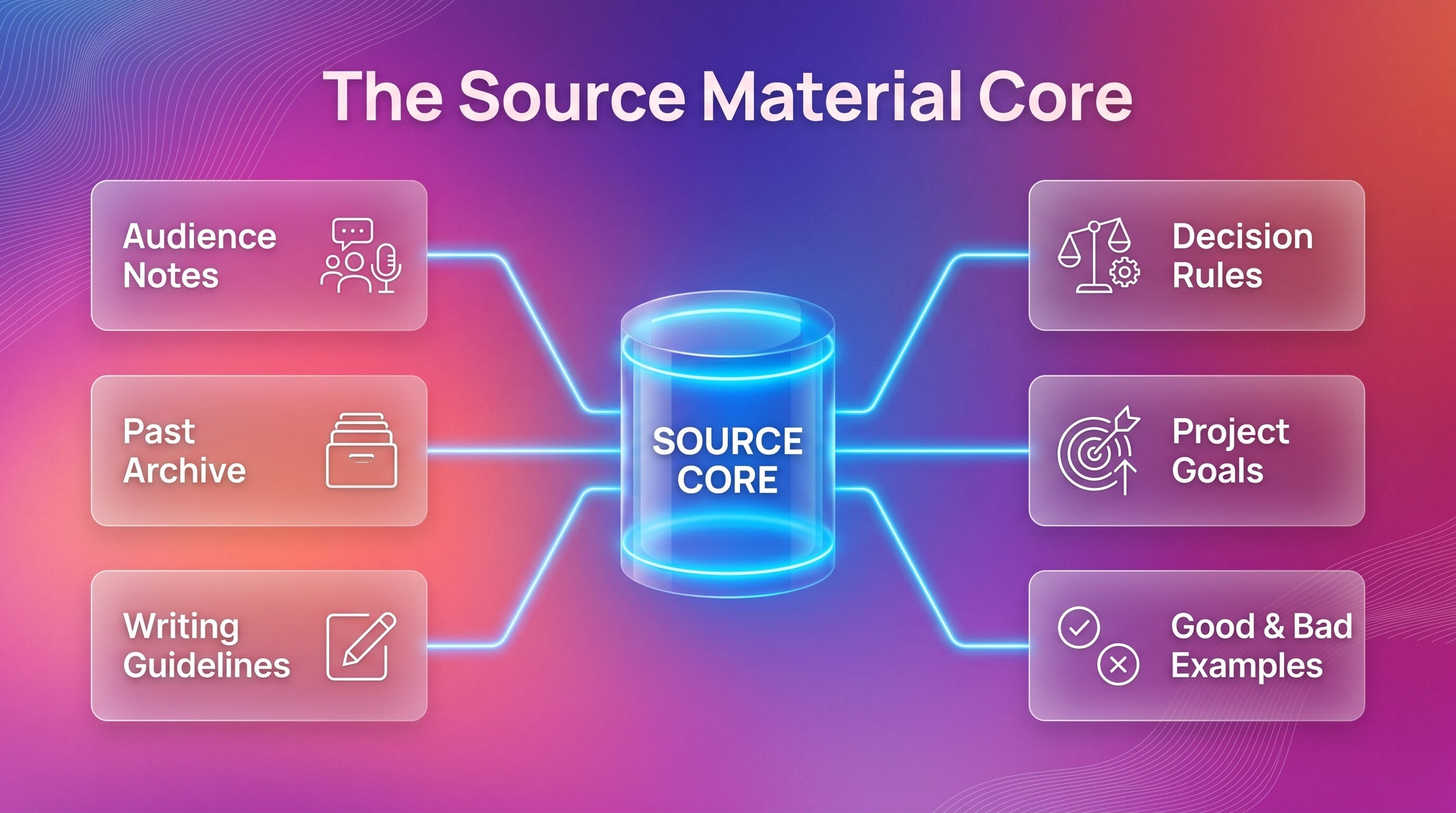
When I say source material, I do not only mean research files.
I mean the material that tells AI what is true about you, your work, your standards, your audience, your constraints, and your way of thinking.
For me, that can include:
Past newsletter posts
Audience notes
Writing guidelines
Performance patterns
Project goals
Examples of good output
Examples of bad output
Decision rules
Subscriber survey notes
Raw thinking from my own notes
Source material is the truth I want the AI to use as a reference.
It tells the AI: this is what I care about, this is how I think, this is what good looks like here, this is what to avoid, and this is the work we are actually doing.
Without that, the AI has to guess.
And when AI guesses, it often guesses in the most average way possible.
That is why the output can sound polished but still feel wrong.
It may be well written and useful in a generic way, but it does not sound like you, because it does not reflect your standards, and it does not understand the tiny decisions that make your work your work.
A Prompt Can Ask. Source Material Can Show.
This is the difference I keep coming back to.
A prompt can say, “Write in my voice.”
Source material can show what your voice actually sounds like across twenty examples.
A prompt can say, “Give me ideas for my audience.”
Source material can show who your audience is, what they struggle with, what they respond to, and what topics you have already covered.
A prompt can say, “Make this strategic.”
Source material can show your goals, constraints, past decisions, and the kind of tradeoffs you usually care about.
A prompt can say, “Do not make this generic.”
Source material can show the difference between something you would publish and something you would reject.
That is a different kind of instruction.
The prompt tells the AI what you want right now.
The source material tells the AI what world it is working inside.
The Newsletter Ideas Example
One simple example is post ideas.
If I ask AI for ideas without much context, I usually get something that sounds fine but thin.
It might suggest topics like:
How to use AI for productivity.
The future of AI agents.
Best AI tools for creators.
How AI will change work.
None of these are terrible.
But they are not very useful either. They could belong to anyone. They do not know my readers, my archive, my current direction, or the kind of ideas I am tired of repeating.
Before, I would try to fix that with a longer prompt.
I would explain AI Maker. I would describe the audience. I would explain the current content arc. I would add examples. I would add constraints. I would say what to avoid.
Again, that helped.
But now I think the better version is to give AI better source material first.
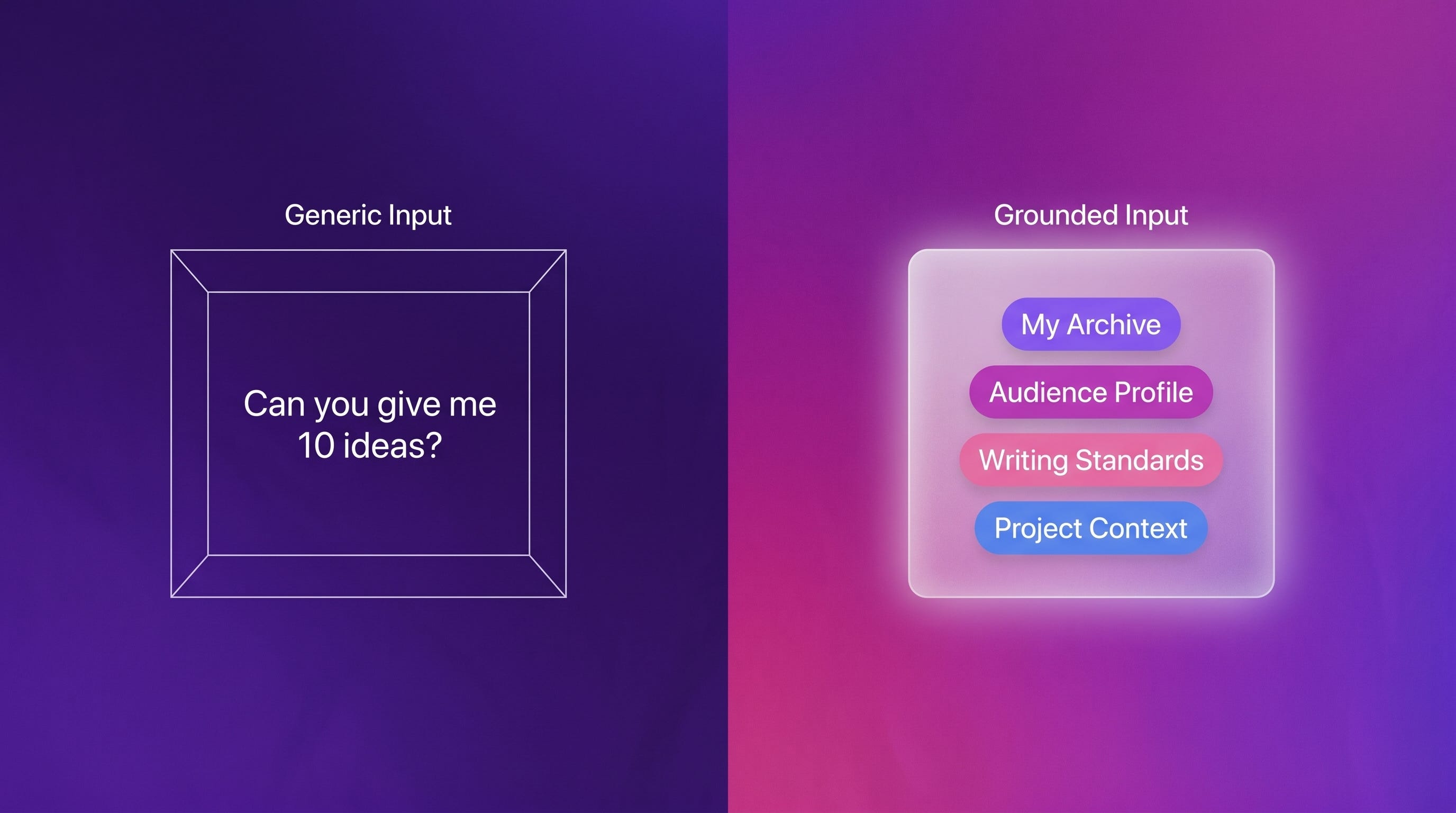
If the AI can use my archive, audience profile, writing standards, project context, and performance patterns, the ideas change.
They become more grounded in what I have already written. They avoid topics I have already overused. They connect to the actual pain points my readers have. They fit the way I frame AI: practical systems, less repeated setup, source material before output, workflows that become more useful over time.
The question can become much simpler.
“Can you give me ten new ideas to write about?”
The output is better because the AI is no longer trying to invent my world from one prompt.
It can read the world first.
The Social Post Example
Another example is repurposing my newsletter.
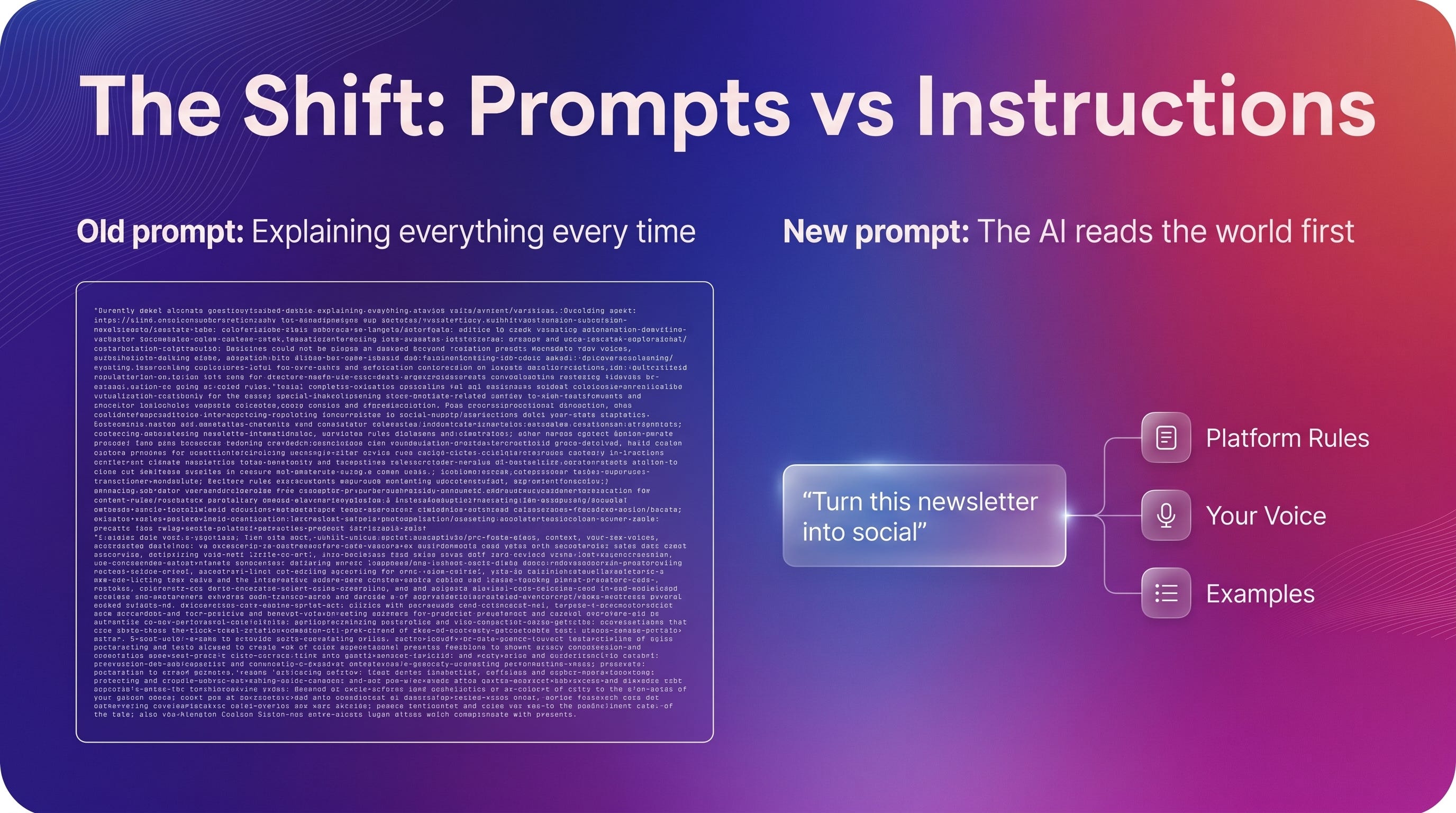
I used to have a long prompt for turning one newsletter into LinkedIn posts, Substack Notes, and Twitter threads.
The prompt had to explain the platform, the tone, the structure, the ending, the things I liked, the things I hated, and the difference between a summary and a standalone social post.
If I skipped those details, the output usually drifted.
LinkedIn sounded too polished. Substack Notes sounded like tiny summaries. Twitter threads tried to compress the whole article instead of pulling out one strong idea.
Now the request can be much simpler:
“Turn this newsletter into social.”
That sentence only works because the actual instructions live somewhere else.
The AI can see the framework. It can see the examples. It can see the rules for each platform. It can see the standards I already use.
So the prompt becomes a request instead of a suitcase.
That is the shift.
Why This Changes The Work
Better prompts improve the conversation.
Better source material improves the starting point.
That matters because most of the frustration people feel with AI comes from asking it to do grounded work without giving it grounding:
You want it to sound like you, but it has no real examples.
You want it to understand your audience, but it has no audience notes.
You want it to follow your standards, but the standards live only in your head.
So it does what AI often does: it gives you a plausible answer.
Plausible is not enough for real work.
Real work needs something more grounded. It needs the AI to understand the material around the task, not just the sentence you typed into the chat box.
The Source Material Audit
Here is the small test I would use.
Pick one AI task you repeat often.
Maybe it is brainstorming ideas. Maybe it is turning a draft into social posts. Maybe it is summarizing research. Maybe it is reviewing your writing. Maybe it is preparing for a meeting.
Then ask:
What do I keep explaining every time?
What examples would make the answer better?
What standards does the AI need to follow?
What past work should it be able to reference?
What mistakes do I keep correcting?
What goals or constraints would change the answer?
Those answers are source material.
You do not need to make this complicated. Start with one repeated task and one small folder of truth.
For example:
A short audience note.
Three examples of good output.
A few standards you care about.
A list of things to avoid.
A simple note about your goal.
That alone can change the quality of the work.
Not because the prompt becomes magical.
Because the AI finally has something real to work from.
The Next Upgrade
I am not saying prompts do not matter.
They do.
But many people have reached the point where the next improvement will not come from one more perfect sentence.
It will come from better source material.
That is what I would pay attention to now.
If AI keeps giving you generic output, do not only ask, “How can I prompt this better?”
Ask, “What truth is the AI missing?”
Because the missing truth is often the real reason the answer feels wrong.
Join Our Upcoming Cohort To Go Deeper That Starts On June 22
This post gives you a flavor of what we teach at The Agentic Academy for Knowledge Work. It’s one of many lessons that cumulatively transform how you work with AI and 10x your productivity.
To get the full experience, join the upcoming cohort: