


It has been a little quiet here for the past two months. Michael Simmons and I have been busy teaching the first Agentic Academy cohort, which has now wrapped up, and there is a lot we want to share from that experience. Later this week, we will also introduce new programs for people who want to learn agentic AI with us. Stay tuned!
We’ll also be regularly publishing new posts in this Substack to help you go deeper into the agentic AI paradigm and get equipped for what’s coming in the next decade. Make sure to subscribe!
Coming out of the first Agentic Academy cohort, I feel even more optimistic about how much of our students’ day-to-day work AI can support. At our Demo Day session, they showed what they had built, and I could see that shift toward agentic AI taking shape in their own work.
One thing stood out to me: most of them had subagents built into their workflows. Some used them to review drafts and analyze their writing. Others assigned subagents different research questions and brought the findings together.
I think I know the why. People still needed to write something, research a topic, or figure out whether what they had produced was good enough. But now they could ask their AI agent to divide parts of that work among subagents, give each one a different assignment, and bring the findings back together.
Seeing those examples made the move from chat AI to agentic AI feel much more concrete to me. You can go beyond asking for an answer and start deciding how the work should be carried out: what needs researching, what needs checking, and which instructions each subagent should follow.
That’s a capability you can build around work you already do. Reviewing a draft with subagents is a useful way to start gaining the benefits of moving to agentic AI.
So in this post, I want to share how subagents fit into my daily workflow for publishing the newsletter three times a week.
I have a routine I follow every time I finish a draft: I trigger a skill called /draft-review-panel and give it the draft file.
The skill deploys eight subagents to review it, each with a different job. One challenges the claims I have made. Another looks for paragraphs that should be cut. Another reads as someone who has never heard of AI Maker and has no idea what I am talking about yet.
Once their reviews are back, a moderator goes through the feedback, looks at where they agree or disagree, and recommends which changes matter most. I get five prioritized fixes, with specific passages to rewrite, move, or remove.
Then I go through those suggestions and decide what actually needs changing. Some feedback gives me a clear edit to make. Other suggestions need more thought, especially when two reviewers want different things from the same paragraph.
Let me walk you through how that works, starting with what a subagent actually is.
What Is a Subagent?
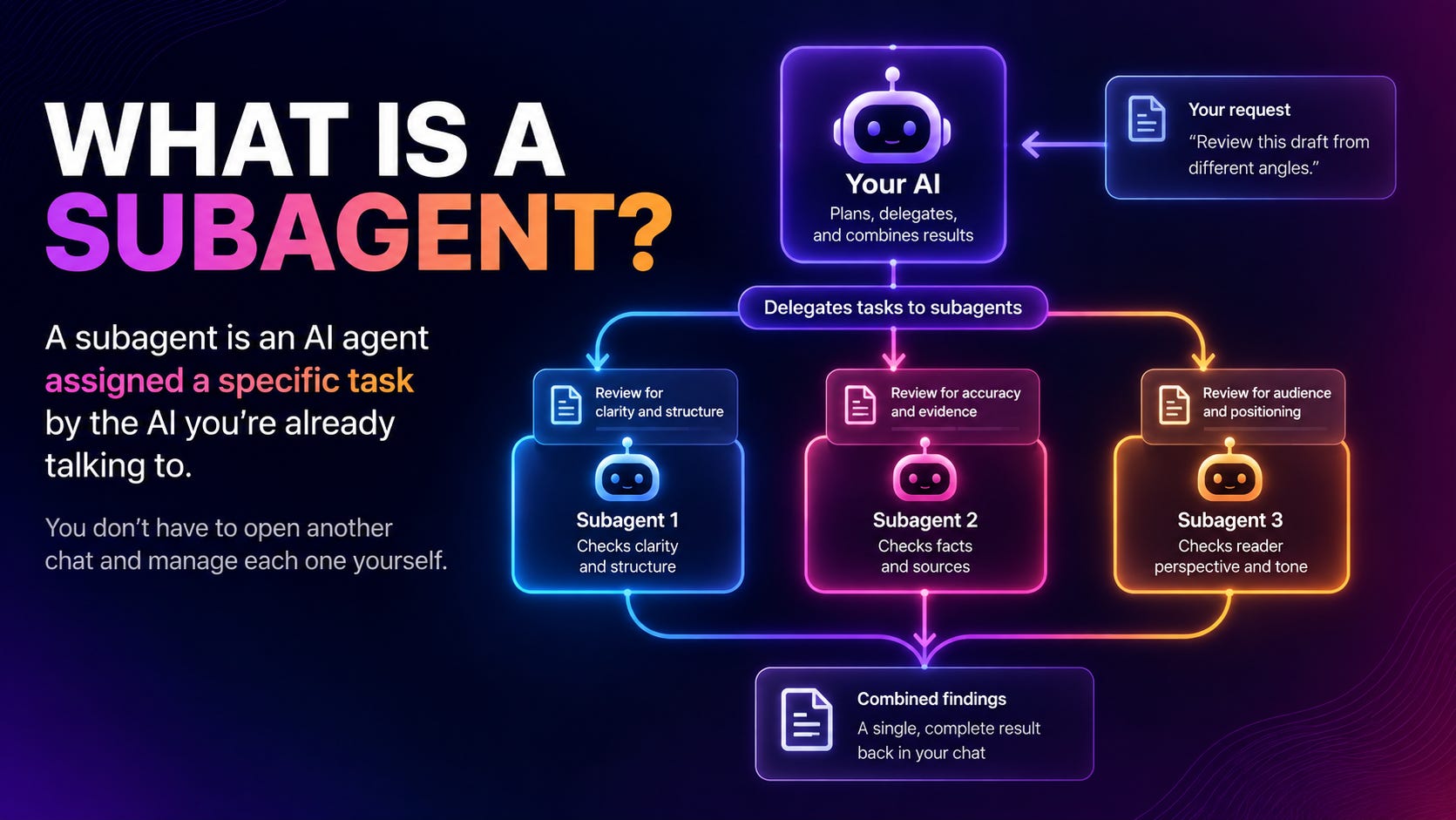
A subagent is an AI agent assigned a specific task by the AI you are already talking to. For example, when I ask for a draft review, the AI in my main conversation can send the draft to several subagents, give each one a different review assignment, and collect their findings.
You do not have to open another chat and manage each one yourself.
How Does It Know What to Do?
Each subagent needs an assignment, the material to work on, and instructions about what to return. For a draft review, that might mean: read this draft, look for claims that lack evidence, and report the specific sentences that need attention.
The main agent or the agent you are talking to, passes those instructions and the draft to the subagent. The subagent does its review separately and sends back its findings. Subagent is a feature available in both Claude Code or ChatGPT Work/Codex, each can work with its own set of instructions and material, without receiving the entire conversation you have had so far.
My skill saves the instructions for this whole process: which subagents to use, what to give them, and how to combine their reviews. That is why I can start it with /draft-review-panel instead of explaining every assignment again.
Why Do I Need Subagents to Review My Draft?
Think about what happens while you write a draft with AI. You try an opening, change your mind, add research, rewrite a section, and drop an idea. By the time you ask for a review, the conversation may contain several versions of the work and plenty of discussion that no longer matters.
As a conversation gets longer, AI can become less reliable at picking out and following the relevant details. This is sometimes called context rot. It does not mean every long conversation becomes useless. It means that adding more material can make it harder for the AI to use the right information consistently.
With a subagent, I can send the current draft and the material needed to review it without including all those earlier attempts and abandoned ideas. That gives the review a more focused starting point.
Another reason I use subagents to review drafts is that each one can embody a specific personality that’s hard to hold in a single agent at the same time. One might be the strict editor who cuts everything fluffy, another might be the curious beginner who asks “so what?”, and another might be the seasoned operator who only cares about practical value.
Which then brings us to the next point.
The Eight Subagents That Review My Newsletter Draft
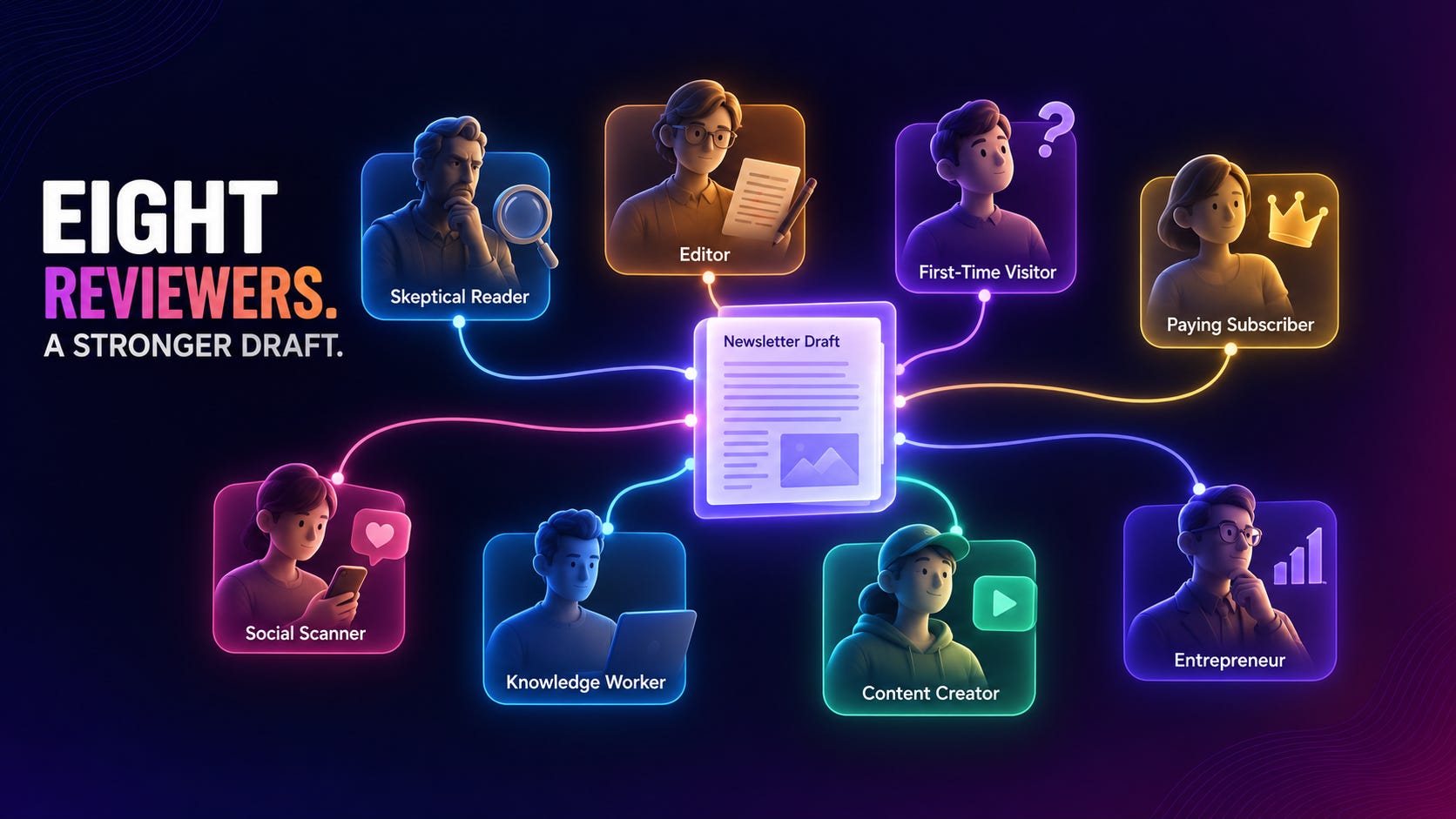
As I mentioned earlier, as part of the newsletter workflow, a skill deploys eight subagents to review each draft, whether it is a free or paid post. Each subagent follows its own set of review instructions:
Skeptical Reader: Which claims need evidence? Where am I asking someone to trust me without showing enough?
Editor: Where does the piece drag, repeat itself, or explain things in the wrong order?
First-Time Visitor: What assumes the reader already knows me or has read my previous posts?
Paying Subscriber: Does the piece deliver the kind of value its free or paid format promises?
Social Scanner: Would the headline earn a click, and do the headings communicate the idea to someone skimming?
Knowledge Worker: Could someone use this at work with the time and tool access they actually have?
Content Creator: Can a creator adapt the idea, and does the writing demonstrate the advice it gives?
Entrepreneur: How does the idea connect to a useful business outcome, and what effort would applying it require?
As you’ll notice, each of them has a different job: The Editor must identify weak paragraphs and propose specific cuts. The First-Time Visitor must flag references that need further explanation. Every reviewer must quote passages from the draft when making a point.
But there’s one last agent in this review process: the moderator. This main agent deploys all of the subagents, compiles their results, identifies where each agent agrees and disagrees, and gives a prioritized list of improvements to apply to the draft.
Having this review process is important in the newsletter publishing workflow because it gives a clearer perspective on how other people react to a draft—whether they find it useful, confusing, too salesy, insightful, actionable, or boring.
What the Panel Found in My Systems-Thinking Draft
I ran this panel using Claude Code on a newsletter draft called “Why Systems Thinkers Are Better at Using AI.” The post explained how to work backward from a desired result and map the information, decisions, and steps an AI workflow needs.
Here’s how it looks in the Claude Code desktop app when all subagents are working.
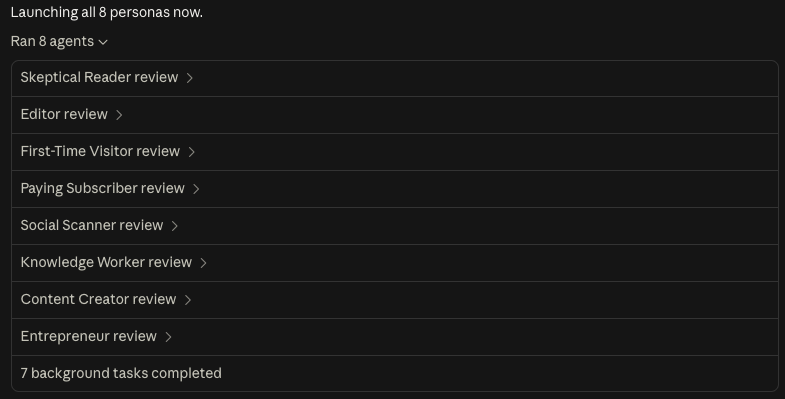
Let me tell you what happened and what it found to my Skeptical Reader and Editor agent.
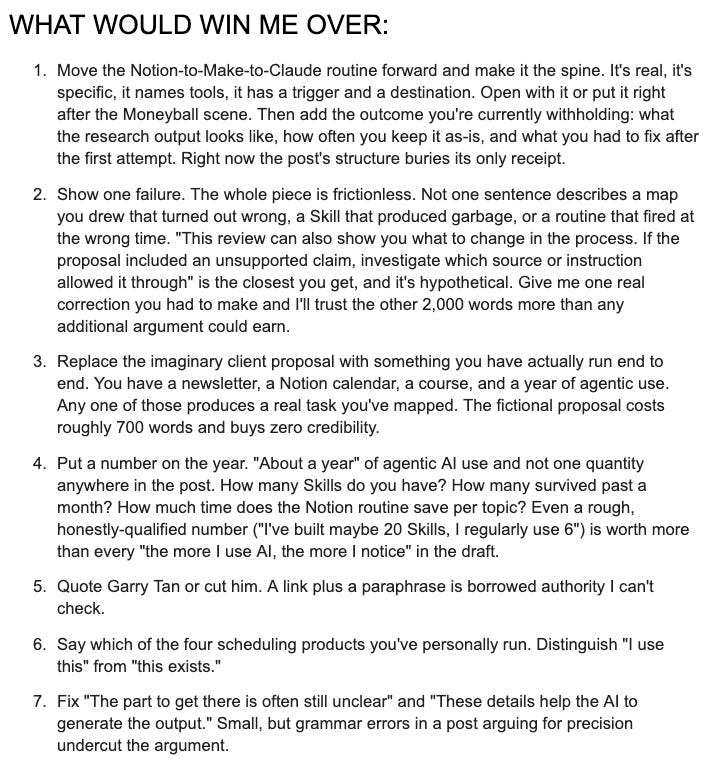
The Skeptical Reader picked up something worth considering. I had used an imagined client proposal to walk through the method. But, later in the draft, I described my own research workflow: changing a topic’s status in Notion starts a process through Make.com and Claude, which researches the topic, saves the findings, and emails me a summary.
The subagent wanted me to explain the real workflow I actually used instead of the imagined one because it can help reader trust my writing more. It also asked what happened after the research arrived: was the output useful, and what still needed checking?
At the end, the Skeptical Reader generated a report that includes a section of “WHAT WOULD WIN ME OVER” which requests what I need to adjust to the draft to improve the draft quality score:
The Editor, on the other hand, noticed that I kept making the same point in different sections of the draft. When explaining Skills, routines, and agents, I repeated why readers should understand a task before asking AI to do it. The review pointed out where I was repeating myself and suggested which paragraphs to shorten or remove.
Both reviews were about the same draft, but their assignments led them to different concerns. One examined whether I had earned the reader’s trust. The other examined where I kept repeating myself all over again.
How the Moderator Handled Conflicting Advice
After reading the individual reviews, the moderator recommended to use my real workflow as the evidence. The article would still center on mapping a process, something readers could apply to their own work, with my workflow showing what that map could become.
That is what the combining step is there to do.
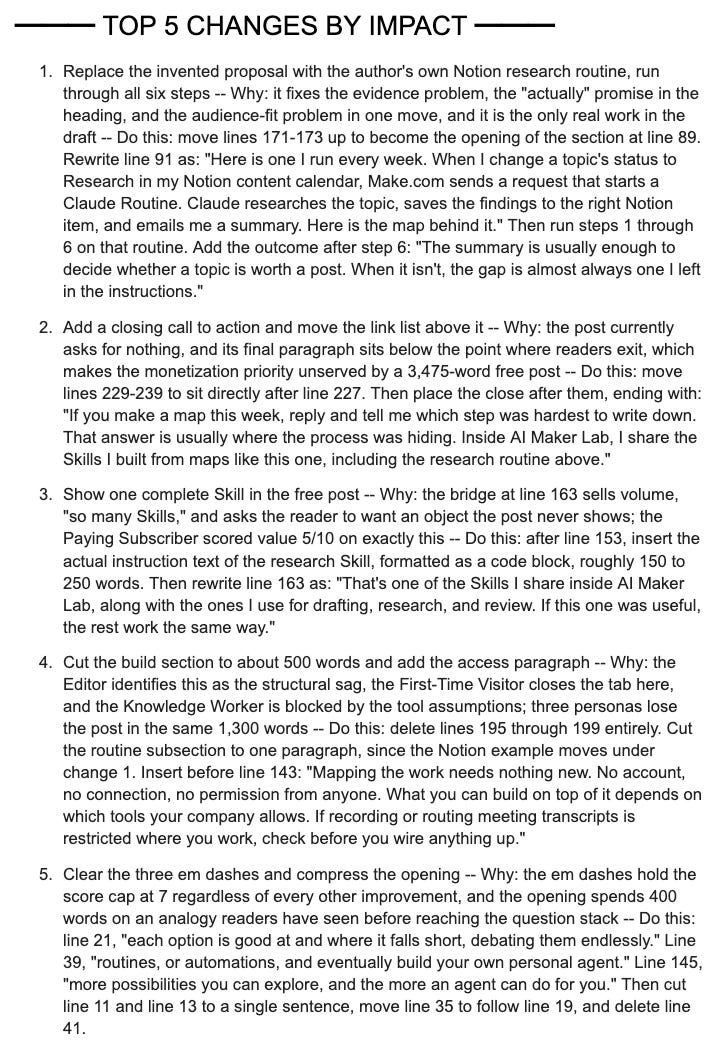
The report also ranked five changes, which helps prioritize what to tackle first.
Ultimately, all subagents generated their individual reports that I can read in detail if I want to understand their reasoning. I still decide which edits will improve the draft, but these reviews opened up new perspectives on how other people read it, which in turn helps improve the work.
Your Reviewers Would Follow Your Work
My eight subagents help my newsletter by looking at it through different people who might read it. You could choose a much smaller panel for a different type of work.
Imagine you are a consultant reviewing a proposal before sending it to a client. One reviewer could compare the scope with the meeting notes. Another could look for promises that go beyond what was agreed. A third could read it as the client and identify questions left unanswered.
Or take a research brief. You could assign one reviewer to compare conclusions with the supplied sources, another to challenge assumptions, and another to check whether the recommendation gives the decision-maker a clear next step.
The material matters as much as the assignment. A scope reviewer needs the meeting notes. An evidence reviewer needs the sources. Otherwise, you are asking it to assess something without giving it the information needed to do the job.
That is what made the Demo Day examples encouraging to me. Students had taken the ability to assign work to subagents and applied it to their own writing and research. In Agentic Academy, we teach people how to build those processes around the work they already need to do. My newsletter panel is one example of what that can look like.
Try a Review Panel on Your Own Work
Pick a draft, report, or proposal you are working on. Attach it or point your agent to the file, along with any sources or standards the reviewers should use. Then try this prompt in an agent tool that supports subagents, such as Claude Code/Cowork and ChatGPT Work.
Replace the bracketed parts with details about your work:
“Review [file or attached draft]. It is for [audience], and its purpose is to [what the reader should understand or be able to do]. Use [sources, examples, or standards] as reference material.
Run three separate subagents, each reviewing the same draft independently:
An evidence reviewer: identify claims that the supplied sources do not support. If you cannot verify something, say what needs checking.
A first-time reader: identify confusing explanations, missing steps, and terms that need explaining for this audience.
An editor: identify repeated points, unnecessary paragraphs, and places where changing the order would make the piece easier to follow.
Give each subagent the current draft, its assignment, and the relevant reference material. Ask each to quote the passages it flags and suggest specific changes.
Once all three finish, compare their findings. Explain any conflicting advice, recommend which advice best serves this draft’s purpose, and rank the three most useful changes. Bring the recommendations back here for me to review. Do not edit the draft yet.
If you cannot launch separate subagents in this tool, tell me before proceeding.”
Try it on something you are already planning to share, and see whether the reviewers point out anything worth changing.
You might keep one review assignment, adjust another, or discover a different check your work needs. That is how you can start building a process you will want to use again the next time a draft is ready.
Seeing students build their own versions of this is part of what made the first Academy cohort so encouraging. I am looking forward to sharing more of these possibilities with you, and seeing what you choose to build around your own work.